Point-Of-Care Testing and Lab Testing Assays and Devices for Protein Biomarkers of Various Diseases
Disease biomarkers include two major categories: proteins and nucleic acids. In diagnostic testing of many diseases (e.g. HIV, Tuberculosis, COVID-19), nucleic acids usually exhibit higher sensitivity because they can be amplified exponentially, thus are detectable earlier after the onset of a disease. However, in many cases, such as HIV, there is no evidence showing that RNA appears ahead of antigen. The major challenge for antigen detection is that proteins cannot be amplified like nucleic acids, leading to the widely held belief that antigen (protein biomarker) tests are relatively insensitive and therefore have a limited clinical utility, which is in fact a technological issue.
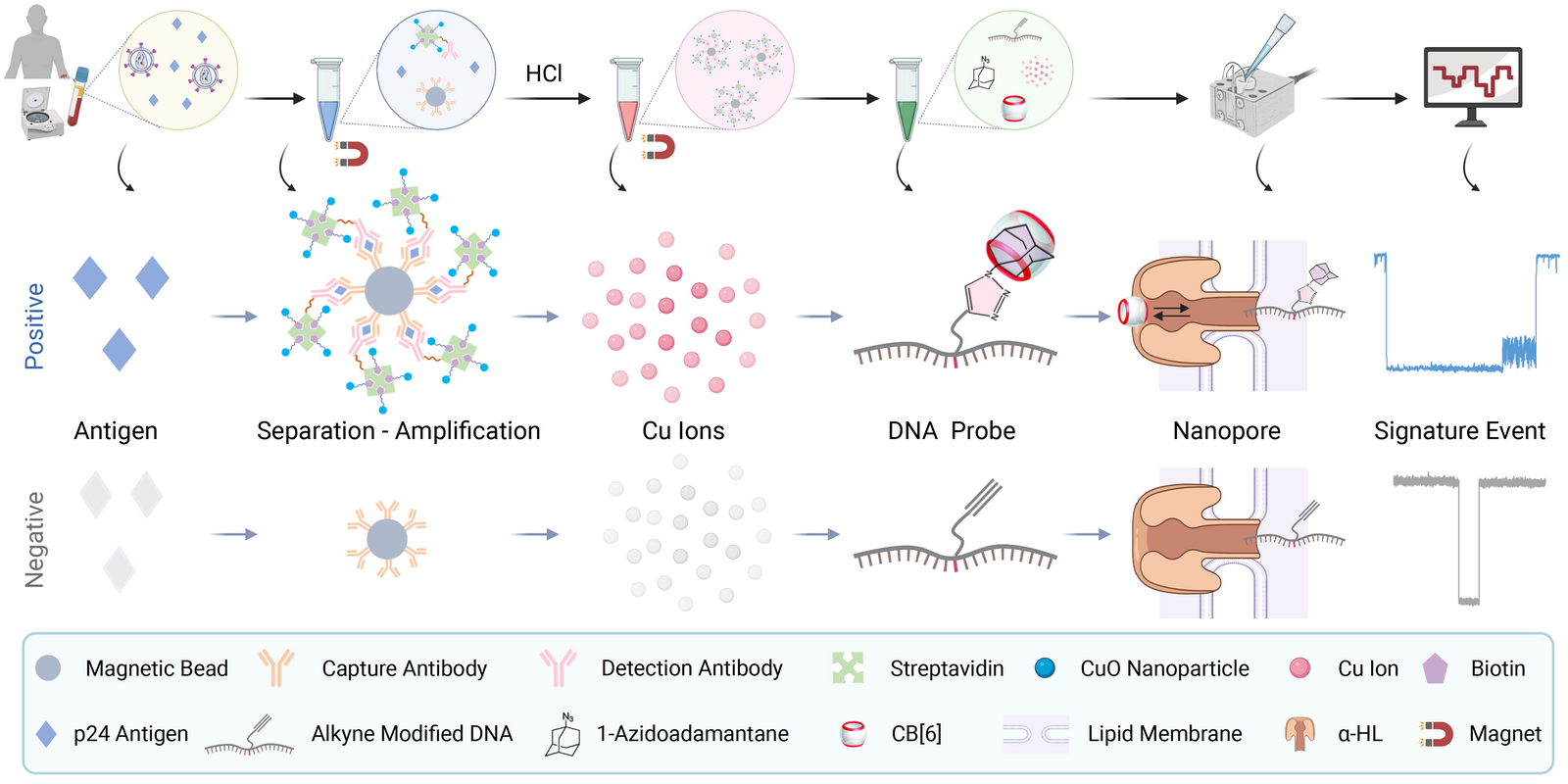
Our lab has developed a click chemistry amplified nanopore (CAN) assay for ultrasensitive circulating antigen quantification. This assay achieved ultralow detection limit in human blood, demonstrating higher analytical sensitivity than latest immunoassays and clinically used benchmark ELISA. Clinical evaluation in HIV and TB patients demonstrated superiority of the CAN assay for quantification at ultra-low concentration range in patients missed by traditional methods.
We are currently developing a streamlined automatic device including a cost-effective microfluidic chip for sample preparation and a nanopore reader for quantification of protein biomarkers in clinical lab testing, POCT, and self-testing applications.